THE TOMB OF AMENHOTEP II (KV 35)
In the Valley of the Kings, in a small lateral branch, lies the tomb of Amenhotep II, the seventh ruler of the 18th Dynasty. It was discovered in 1898 by the French archaeologist Victor Loret.
A corridor descends to a vertical shaft, on the other side of which is a transverse antechamber with two pillars. In this room, the access corridor bends to the left at a 90-degree angle, the typical structure of royal tombs of this period.
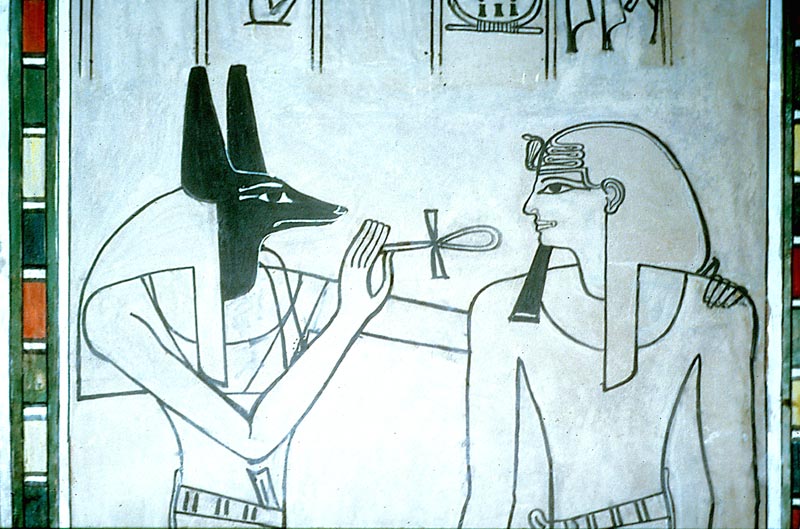
A staircase leads to the burial chamber. This imposing quadrangular room is characterized by six large pillars, decorated with scenes of the ruler in the presence of deities, and by a ceiling painted with a motif of yellow stars on a dark blue background.
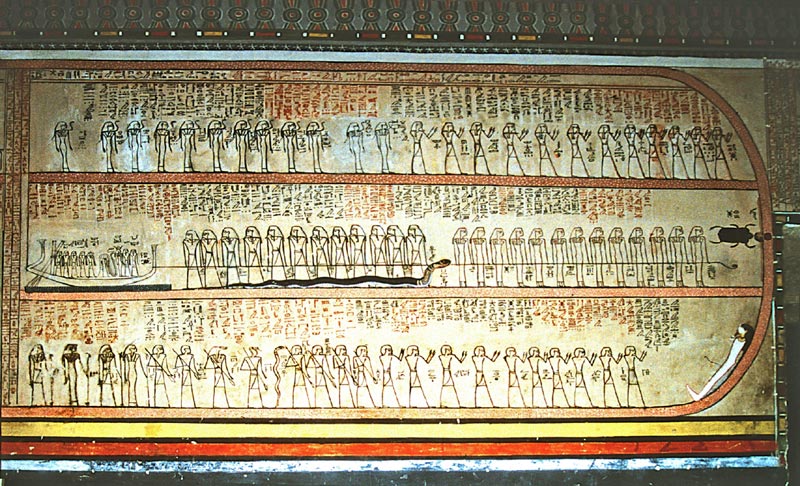
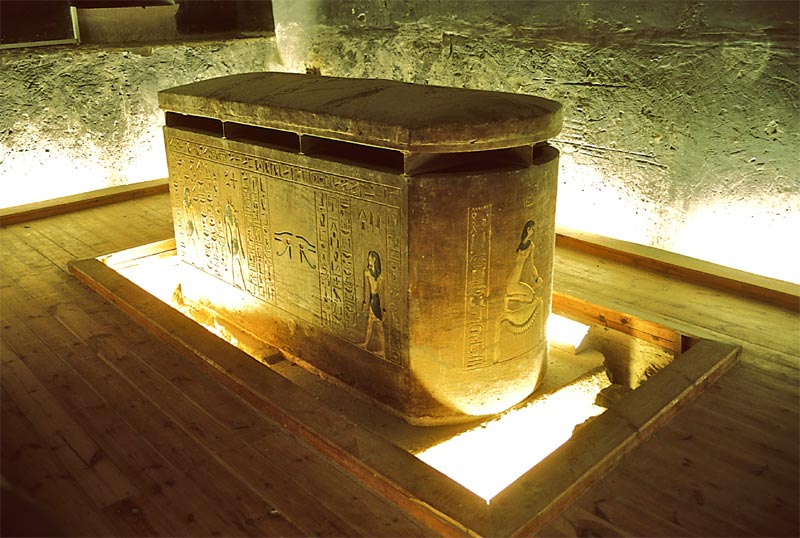
Located below the floor of the burial chamber is the cartouche-shaped quartzite sarcophagus, which at the time of its discovery still contained the king’s body, adorned with floral crowns. The sarcophagus room is the only decorated room in the tomb; on the walls, the Amduat texts are rendered with quick but refined strokes against a light background, and the entire decoration resembles a papyrus scroll unrolled on the walls, as can also be seen in the tomb of his father Thutmose III (KV34).
Amenhotep II’s mummy was not the only one present in the tomb. During the Third Intermediate Period, when the Theban necropolises were being heavily looted, officials in charge of the West Bank, including Butehamun, sought to protect at least the mummies of the rulers, now stripped of their jewels, and identified several sites deemed safe: tomb DB320 at Deir el-Bahari and KV35 were used as caches for Egypt’s great rulers.
The mummies of at least nine rulers, including Amenhotep III, Thutmose IV, Merenptah, Ramesses IV, V, and VI, were placed in reused sarcophagi bearing hieratic inscriptions attesting to the movements the mummies had undergone before their final placement in KV35. In another annex were the unwrapped mummies of two women and a boy: the older woman, called the “Elder Lady,” was later identified as Queen Tiye.
Some partially broken objects remain from the tomb’s original grave goods: a model of a boat, now on display in the Luxor Museum, on which the king is depicted as a sphinx slaying his enemies; several ushabtis; statues of animals and deities with bodies covered in black resin, like those later found in Tutankhamun’s tomb (KV62); fragments of furniture and chests; and blue faience objects.
The tomb is currently closed to the public.